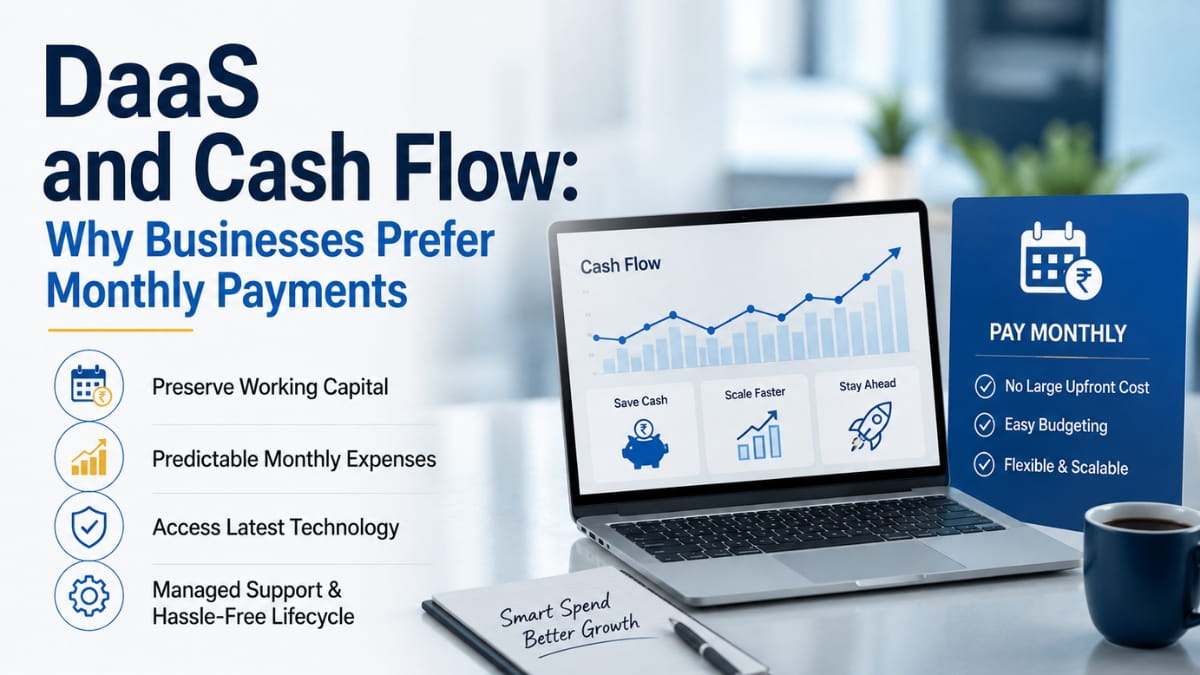

Device as a Service (DaaS) is a business technology model in which companies access laptops, desktops, MacBooks or other workplace devices through a recurring payment rather than purchasing every device outright. Depending on the provider and contract, the monthly price may include hardware, deployment, technical support, maintenance, security services, lifecycle management, upgrades and end-of-term handling.
DaaS is primarily designed for businesses that need multiple devices but want greater predictability in technology spending. It can be particularly relevant for growing companies, startups, enterprises, organizations with frequent employee onboarding, and businesses that prefer to avoid large one-time hardware purchases. The model addresses a practical problem: technology needs often arrive before the business has generated the cash associated with those new employees, projects or contracts.
Cash flow matters because a profitable business can still experience financial pressure when cash arrives later than expenses are due. Government business guidance similarly emphasizes forecasting incoming and outgoing cash to identify potential shortages and plan future payments. The Federal Reserve’s 2025 report on employer firms found that 51% of surveyed firms cited uneven cash flows as a financial challenge, while 56% cited paying operating expenses.
This is where DaaS can become financially interesting. Instead of spending a large amount of cash on 20 or 50 laptops at once, a company can spread device-related payments over an agreed period. The business gets access to the technology it needs while retaining more cash for payroll, inventory, marketing, expansion, working capital or other strategic priorities.
However, DaaS should not automatically be described as “cheaper.” The main financial advantage is often cash-flow timing, predictability and flexibility, not necessarily a lower total cost than buying equipment outright.
What Is Device as a Service (DaaS)?
Device as a Service combines computing hardware with recurring payments and, in many implementations, lifecycle services. Rather than treating a laptop as a one-time purchase, the business treats the device as part of an ongoing technology service.
A typical DaaS arrangement can cover the device itself along with services such as configuration, deployment, technical support, repairs, security, monitoring, device replacement, upgrades and retirement. The exact package varies significantly between providers, so businesses should examine what is actually included rather than assuming every DaaS contract provides the same services.
For example, HP describes its DaaS model as combining devices, lifecycle services and expertise with a per-seat, per-month cost structure. Dell’s PC-as-a-Service offering similarly combines hardware, software and lifecycle services into a predictable price per user.
The important distinction is that DaaS is more than simply paying for a laptop in installments. A genuine DaaS model can shift responsibility for parts of the device lifecycle to the provider, allowing the customer’s IT team to focus less on procurement, deployment, repairs and replacement logistics.
Why Cash Flow Is So Important for Businesses
Cash flow represents the movement of money into and out of a business. Revenue and profit are important, but neither automatically guarantees that sufficient cash is available when bills become due.
A company might invoice customers on 30- or 60-day terms while paying employees, suppliers and service providers much sooner. If a major hardware purchase is added to those commitments, the timing mismatch can become more noticeable. Government guidance for businesses recommends using cash-flow statements and forecasts to anticipate shortages and understand future payment requirements.
The challenge becomes more significant during periods of growth. Hiring ten employees may increase revenue potential, but the company could need ten laptops, accessories, software licenses and other resources before those employees start producing revenue. Hardware therefore creates an upfront cash requirement that may arrive before the associated business benefit.
For this reason, businesses increasingly evaluate IT procurement not only by asking “How much does this laptop cost?” but also by asking “When does the cash leave the business, and what else could that cash be used for?”
The Cash-Flow Problem With Buying Laptops Outright
Suppose a company needs 30 business laptops at an average purchase price of ₹60,000 per device. The hardware purchase alone would require ₹18 lakh before considering accessories, deployment, warranties, software, maintenance or other related expenses.
The company may be able to afford the purchase. But affordability and cash-flow efficiency are not necessarily the same thing. Paying ₹18 lakh immediately means that amount is no longer available for other business requirements, even though the laptops will deliver value over several years.
A large purchase can therefore create an opportunity-cost question. Could some of that ₹18 lakh have been used to hire another employee, purchase inventory, fund marketing, maintain an emergency reserve or take advantage of a time-sensitive business opportunity?
This does not mean buying is wrong. Businesses with strong cash reserves, long device lifecycles and straightforward IT requirements may find outright ownership financially attractive. The important point is that the lowest purchase price and the best cash-flow decision are not always the same decision.
How Monthly DaaS Payments Change the Cash-Flow Equation
Under a DaaS arrangement, the business may replace a large upfront hardware outlay with a recurring payment. Instead of allocating the entire acquisition cost to the beginning of the device lifecycle, the business pays according to the contractual schedule.
For example, imagine that the same 30-device requirement is structured at an illustrative monthly cost of ₹2,000 per device. The monthly device commitment would be ₹60,000, subject to the actual services, contract terms, taxes and provider pricing.
The business does not simply “save” the difference between ₹18 lakh and ₹60,000. It is changing the timing and structure of cash outflows. That distinction is critical when evaluating DaaS. The total amount paid over the contract can be higher than the purchase price because the service may include financing, support, lifecycle management and other services.
Illustrative comparison
| Factor | Buy Outright | DaaS / Monthly Model |
|---|---|---|
| Initial hardware payment | High | Lower or potentially none |
| Monthly device payment | Usually none after purchase | Recurring |
| Upfront cash requirement | High | Lower |
| Budget predictability | Depends on repairs/upgrades | Usually higher |
| Maintenance responsibility | Generally business | May be partly provider-managed |
| Device refresh | Business decides and funds | May be built into contract |
| Ownership | Business owns device | Depends on agreement |
| Total cost | Often lower for long-term ownership, but varies | May be higher, depending on services and terms |
The table demonstrates why DaaS should be evaluated as a cash-flow and lifecycle-management model, not simply as a cheaper way to buy hardware.
DaaS Helps Businesses Preserve Working Capital
Working capital gives a business room to operate between incoming and outgoing payments. When a company commits a large amount of cash to hardware, that money cannot simultaneously be used for other immediate needs.
DaaS can help preserve some of that liquidity by spreading device-related expenditure over time. This can be particularly useful for businesses where cash has a higher potential return when deployed elsewhere, such as inventory purchases, customer acquisition, hiring, product development or expansion.
Consider a growing recruitment company that wins a large new client requiring 25 additional employees. Buying 25 laptops immediately could require a substantial cash outlay before the new contract begins generating enough revenue to cover those costs. A monthly device model can align technology expenditure more closely with the period during which the devices are being used.
This is one reason monthly technology models can appeal to growth-oriented businesses. They provide a way to acquire productive assets without necessarily committing the entire purchase amount on day one.
Predictable Monthly Payments Make IT Budgets Easier to Forecast
Budget predictability is another major reason businesses consider DaaS. A laptop purchase might appear to have a simple price, but the actual cost of operating a device can include deployment, repairs, replacement components, technical support, security, disposal and eventual refresh.
When appropriate services are bundled into a DaaS contract, more of these costs can potentially be incorporated into a recurring payment. HP, for example, describes its managed-device model as providing predictable monthly costs, while Dell promotes predictable monthly payments alongside deployment, management, security, support and retirement services.
This can make monthly IT forecasting easier because finance teams can establish a recurring technology budget rather than attempting to predict every repair or replacement event independently. The benefit depends heavily on the contract, however, so businesses should verify exactly which services are included and which costs remain variable.
DaaS Can Make Technology Costs More Closely Match Business Usage
A traditional hardware purchase requires the business to make a large investment before the device begins producing value. DaaS introduces a different way of thinking: the company pays over the period in which it uses the technology.
This can be particularly useful when device requirements fluctuate. A company may grow rapidly during one year, maintain a stable workforce for another period and then restructure its workforce later. A rigid ownership model can leave the business with excess equipment, while a well-designed DaaS contract may offer more flexibility around deployment, refresh and scaling.
Dell describes its PC-as-a-Service offering as supporting flexible scaling based on business requirements, while HP similarly positions managed device services around models that can adapt to changing business needs.
The practical lesson is simple: match the contract duration and device quantity to realistic business requirements. A flexible service can still become expensive if a company commits to more devices or longer terms than it actually needs.
DaaS and CAPEX vs OPEX: An Important Distinction
DaaS is frequently described as a way to move technology spending from CAPEX (capital expenditure) toward OPEX (operating expenditure). This description can be useful at a high level, but businesses should avoid assuming that every DaaS agreement will receive identical accounting treatment.
The accounting outcome depends on the contractual structure, ownership rights, identified assets, services and applicable accounting standards. Under IFRS 16, for example, many leases are recognized by lessees through a right-of-use asset and lease liability rather than simply being treated as ordinary operating expenses.
Therefore, DaaS should not be sold internally as a guaranteed method of keeping liabilities off the balance sheet or automatically converting every hardware cost into an operating expense. Finance teams should review the actual contract with their accountant or financial adviser before making accounting or tax assumptions.
The stronger business argument is usually predictable spending, reduced upfront cash requirements and simplified device lifecycle management, rather than a simplistic CAPEX-versus-OPEX claim.
A Practical Example: 25 Laptops for a Growing Company
Imagine a consulting company with 75 employees. It wins a new project and needs to onboard 25 additional employees within two months. Each employee needs a business laptop, and the company also wants warranty support, device replacement and a predictable refresh cycle.
If the company purchases 25 laptops at an illustrative ₹60,000 each, the hardware purchase is ₹15 lakh. That money leaves the business immediately, even though the laptops may remain productive for several years.
Under a hypothetical DaaS arrangement, suppose the provider charges ₹2,500 per device per month for hardware and specified lifecycle services. The monthly commitment for 25 devices would be ₹62,500. Over 36 months, the illustrative contractual payments would total ₹22.5 lakh.
The DaaS option therefore costs more in this simplified example. But the comparison is not simply ₹15 lakh versus ₹22.5 lakh. The DaaS figure could include services that the ownership model requires the company to purchase separately, and the ownership model leaves the company responsible for residual value, repairs, deployment and future refresh decisions.
The finance question becomes: Is retaining ₹15 lakh of cash today worth the additional contractual cost and reduced ownership flexibility? The answer depends on the company’s cost of capital, cash position, growth plans, device utilization, support requirements and the exact DaaS contract.
When Monthly Payments Can Be Particularly Useful
DaaS can be attractive when a company’s technology requirements are closely connected to employee growth or changing business demand. A startup hiring aggressively, for example, may prefer predictable device expenditure instead of making repeated large purchases every time headcount increases.
It can also make sense for businesses operating across multiple locations. Coordinating procurement, configuration, repairs and replacement across several offices can consume significant administrative time. A provider-managed lifecycle can potentially consolidate those activities into one commercial relationship.
DaaS may also be relevant for organizations with frequent technology refresh requirements. If employees need current hardware for demanding workloads, a lifecycle-based model can provide a structured route for replacement rather than leaving the company to manage a large refresh project every few years.
Businesses that may consider DaaS include:
- Startups and rapidly growing companies
- Recruitment and staffing firms
- IT and software companies
- Consulting businesses
- BPO and call-center operations
- Healthcare organizations
- Training and education companies
- Enterprises with distributed teams
- Businesses with frequent employee onboarding
- Companies managing multiple offices
DaaS Can Reduce the Financial Impact of Unexpected Device Costs
A traditional device fleet can generate unpredictable costs. A laptop may fail outside warranty, require a replacement component, become unsuitable for an employee’s workload or need replacement sooner than expected.
These costs are difficult to forecast individually. A DaaS agreement that includes defined support and replacement services can make some of those expenses more predictable. The exact benefit depends on service-level agreements, exclusions, damage policies and replacement conditions.
This distinction matters because a monthly payment is only predictable if the contract itself is predictable. Businesses should carefully check whether accidental damage, battery replacement, onsite support, software services, accessories, logistics and replacement devices are included or billed separately.
The IT Productivity Side of the DaaS Equation
Cash flow is only one part of the business case. Device management also consumes employee and IT resources. Procurement teams may spend time obtaining quotes, IT teams configure devices, administrators maintain inventories, employees report faults and finance teams process invoices.
A mature DaaS program can consolidate several of these activities. Dell, for example, describes PC-as-a-Service as covering areas including provisioning, management, security, support and end-of-term retirement. HP similarly positions managed device services around reducing the complexity of procuring, deploying, supporting and refreshing devices.
The resulting value is not always visible as a line item on the IT budget. If an IT employee spends less time chasing hardware problems and more time on cybersecurity, infrastructure or business systems, the organization may gain value without reducing its number of IT employees.
What Businesses Should Check Before Choosing DaaS
The monthly price should never be the only factor in evaluating a DaaS provider. Two providers may quote similar monthly prices while offering substantially different devices, support levels, replacement policies and end-of-contract conditions.
Start by defining the business requirement. Determine the number of users, device specifications, expected contract duration, employee locations, support requirements and expected growth. Then request a complete commercial proposal that separates hardware, services, taxes, deposits, setup fees and optional charges.
Key questions to ask a DaaS provider
- What exactly is included in the monthly payment?
- Is technical support included?
- What happens if a device fails?
- Is device replacement included?
- What are the response and resolution times?
- Are accidental damages covered?
- Can devices be upgraded during the contract?
- What happens when an employee leaves?
- Can the number of devices be increased or reduced?
- Who owns the devices at the end of the contract?
- Are there early-termination charges?
- Are there setup, delivery or installation fees?
- What happens to company data when devices are returned?
- How are devices securely wiped or retired?
- Does the agreement contain minimum quantities or long commitments?
These questions turn a simple price comparison into a proper total cost of ownership and cash-flow analysis.
DaaS vs Buying: Which Is Better for Cash Flow?
There is no universal winner. Buying can be financially attractive when a business has sufficient cash, wants ownership, expects to keep devices for a long period and has the internal resources to manage the fleet.
DaaS can be attractive when preserving cash, achieving predictable monthly expenditure, simplifying lifecycle management or scaling the device fleet is more important than minimizing the initial purchase price.
The correct comparison should therefore consider total cost, cash timing, operational workload, residual value, flexibility and business priorities. A company with abundant cash may reasonably choose ownership, while a fast-growing company with competing demands for working capital may prefer monthly device payments.
DaaS Is About More Than Paying Monthly
One of the biggest misconceptions about Device as a Service is that it is simply laptop financing. While monthly payments are an important component, the broader value proposition can involve the complete lifecycle of a business device.
A well-designed DaaS model can combine procurement, deployment, support, maintenance, security, replacement, refresh and retirement. Dell’s current PC-as-a-Service offering, for example, describes a single per-seat monthly price covering hardware, software and lifecycle services, while HP similarly combines devices and lifecycle services into managed-device offerings.
That distinction matters for finance teams. The objective should not be to minimize the laptop’s monthly rental price in isolation. The objective should be to create a technology model that gives the business the right equipment, appropriate support and a predictable financial commitment without creating unnecessary contractual restrictions.
How to Evaluate the Real Financial Benefit of DaaS
Before signing a DaaS contract, finance and IT teams should build a three- to five-year comparison between ownership and the proposed service.
For the ownership scenario, include the purchase price, deployment, warranty extensions, repairs, accessories, internal IT time, replacement devices, asset disposal and expected residual value. For DaaS, include all monthly payments, setup charges, taxes, deposits, excess-use charges, termination fees and any services that are outside the base subscription.
The next step is to model cash timing rather than just total cost. Put each expected payment into a monthly cash-flow forecast and compare it with projected revenue, payroll, supplier payments and other commitments. Government guidance specifically recommends cash-flow forecasting to identify potential shortages and plan future costs.
A simple evaluation framework
| Question | Why it matters |
|---|---|
| What is the total three-year cost? | Shows the overall financial commitment |
| How much cash is required upfront? | Measures immediate liquidity impact |
| What is the monthly commitment? | Helps budget and forecast |
| What services are included? | Prevents misleading price comparisons |
| What happens when devices fail? | Identifies operational risk |
| What happens at contract end? | Determines flexibility and residual value |
| Can device quantities change? | Important for growing or shrinking teams |
| What are the termination costs? | Measures contractual risk |
Real-World Industry Evidence Behind the DaaS Model
DaaS is not a theoretical concept created by small equipment-rental businesses. Major technology companies have developed structured device-as-a-service programs around the same principles of predictable payments, lifecycle services and reduced procurement complexity.
HP introduced its Device as a Service offering with a single contract covering devices and services and described predictable costs and flexible allocation of funding as key benefits. Dell’s current PC-as-a-Service offering similarly emphasizes predictable monthly payments, flexible terms and lifecycle services.
IDC research also provides evidence that organizations use DaaS for reasons beyond financing. An IDC study published in 2025 reported that surveyed organizations identified benefits including better employee experience, easier optimization of device fleets, sustainability and more stable device choices. Because the research was commissioned by a financing provider, its findings should be considered in that context rather than treated as independent proof of financial superiority.
The Most Important Limitation: DaaS Does Not Automatically Save Money
Businesses should be cautious of claims that DaaS always reduces IT costs. A monthly service can have a higher total contractual cost than buying devices outright, particularly when the ownership option has a long useful life and minimal maintenance requirements.
The value comes from what the business receives in return for that additional cost: liquidity, predictable expenditure, support, flexibility, device lifecycle management and potentially reduced administrative workload.
The right question is therefore not “Is DaaS cheaper than buying?” It is “Does the additional cost, if any, provide enough financial and operational value for our business?” That question produces a much more useful procurement decision.
Practical Takeaways for Businesses
DaaS can be a powerful way to rethink technology procurement, particularly for organizations where cash-flow flexibility and predictable IT spending matter. Instead of making every device purchase a separate capital decision, a company can establish a recurring technology budget aligned with its workforce and operating requirements.
Before adopting the model, businesses should compare the full lifecycle cost of ownership with the full DaaS cost. They should also evaluate contract flexibility, support levels, replacement policies, security, device specifications and end-of-term obligations.
For a growing company, the strongest DaaS proposition may not be the promise of a cheaper laptop. It may be the ability to get the required technology today while keeping more cash available for the business activities that generate growth.
FAQs
DaaS can reduce the size of an upfront hardware payment by spreading device-related costs across recurring payments. This allows a business to retain more cash for payroll, inventory, marketing, expansion or working capital. The actual cash-flow benefit depends on the contract structure, pricing, deposit requirements and services included.
Not necessarily. DaaS can have a higher total contractual cost because monthly payments may include financing, technical support, maintenance, lifecycle management and other services. Businesses should compare the total cost of ownership rather than comparing only the laptop purchase price with the monthly DaaS fee.
Not always. Laptop rental generally focuses on providing a device for a defined period, while DaaS typically combines devices with recurring payments and broader lifecycle services. However, the terminology varies between providers, so businesses should examine exactly what a particular provider means by DaaS.
DaaS is often marketed as an operating-expense or consumption-based model, but businesses should not assume that every DaaS contract receives identical accounting treatment. Lease and service components can have different accounting implications. Businesses should have their finance or accounting team review the specific contract and applicable accounting standards.
DaaS can be particularly useful for growing companies, organizations with frequent employee onboarding, businesses with distributed teams and companies that want predictable technology expenditure. It can also benefit organizations that want to outsource parts of device deployment, support, replacement and lifecycle management.
Compare the total contract cost, monthly payment, upfront charges, device specifications, warranty and support, replacement policy, security, upgrade options, scalability, minimum commitment, early-termination terms and end-of-contract conditions. Also determine whether the quoted monthly price includes services such as deployment, repairs and device retirement.
Final Takeaway
The strongest reason businesses consider DaaS and monthly device payments is not simply that monthly payments look smaller than a large hardware invoice. It is that DaaS can change the timing, predictability and management of technology expenditure.
For companies that need to preserve working capital, scale quickly or reduce the administrative burden of managing device fleets, this can be strategically valuable. For companies with strong cash reserves and a preference for long-term ownership, buying may still be the better financial choice.
The right decision comes from comparing cash flow, total cost of ownership, operational requirements and business flexibility together. DaaS works best when the commercial structure matches the way the business actually hires, operates, grows and uses technology.

Sarita is a Rental Operations Executive at Rentio, specializing in laptop and IT equipment rentals. She helps businesses choose the right devices, coordinates seamless deliveries, and shares practical insights on technology, device configurations, and rental solutions.